What sea turtles taught me about patience
Meda Căpîlna writes from a marine conservation centre in Thailand: the unglamorous daily work, the very long timescales, and what it all means for children.
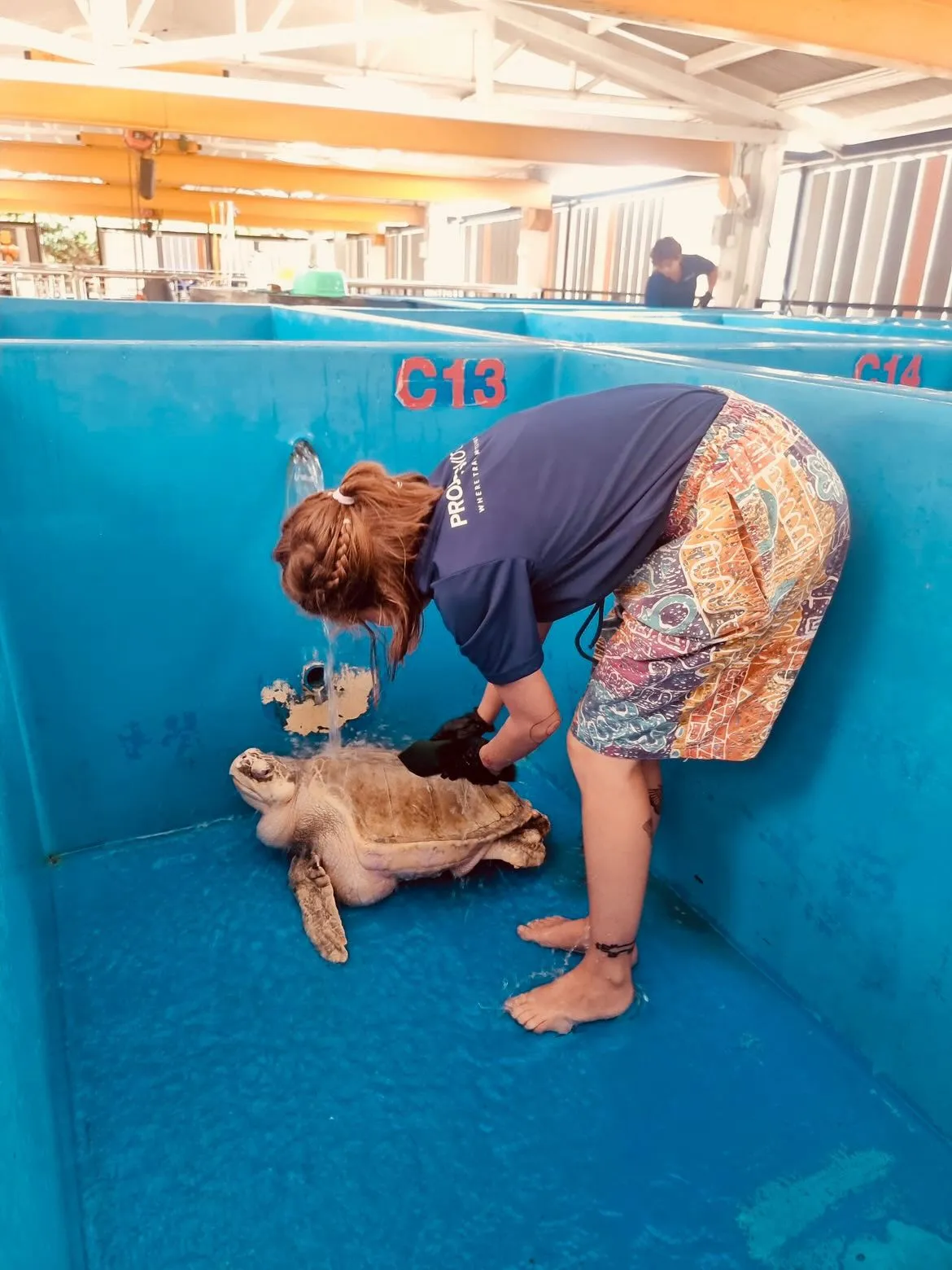
I went to Thailand with the image everybody has: you release turtle hatchlings on a beach at sunset and watch them head for the ocean. That image exists. It lasts twenty minutes and is a tiny fraction of what happens at a marine conservation centre.
The rest is cleaning tanks.
The actual work
On an ordinary day it starts with the tanks. The water has to be changed, the walls scrubbed of algae, the filters checked. Then feeding, which is not a charming scene but an operation with measured quantities and written notes. Then checking each animal: how the shell looks, how it swims, whether it ate everything.
Then you write. Everything is recorded. The same columns, every day, for every animal.
In the first days this struck me as paperwork. Halfway through I understood that those notes are the work, and the rest is maintenance. An animal that falls ill does not announce it. You see it in three weeks of data laid side by side, in which it ate slightly less each time. Without the notebook, there is no way to see it.
The timescale
A sea turtle reaches sexual maturity after twenty to thirty years. A hatchling released today will count towards the population somewhere around 2050, if it survives — and most do not.
It is an idea that changes something in you once you follow it all the way through. Nobody at that centre will see the result of their own work. The people who started the programme will not know whether it worked. You are working towards a measurement taken after you have gone.
Like everyone, I grew up in a culture that ties effort to fast feedback. You do something, you see immediately whether it worked. Conservation severs that link completely. And to my surprise, the people there were not frustrated. They were the calmest people I have ever worked with.
Why this matters for children
I came back with a change in how I talk to children about nature.
Before, I would have gone for emotion: look how beautiful the ocean is, let’s protect it. That approach works for five minutes and then evaporates, because it gives the child nothing to do.
Now I go with what I saw there: protection means one small thing repeated over a long time, usually without an audience. Children like this version more than I expected. It is concrete. You can be part of it from the age of six, if somebody gives you a real task and keeps you at it.
When a child looks after something for weeks — a plant, a corner of the yard, a shelter for birds — and sees that it genuinely depends on them, they learn exactly what I learned in my twenties in those tanks. Only earlier.
What I left out
I left out the hard part, so here it is: some animals die. It happens even when you do everything right. Volunteers get attached, and then have to write a note and move to the next tank.
I don’t think it is a part we need to hide from children. I think it is the part that makes the rest matter.
Transcript
The clip above was filmed by Projects Voyage, the organisation I went through, on the last day of the volunteering month. The transcript below is checked against the audio, word by word.
Hello everybody, my name is Meda and I just finished today a full month of volunteering. To say this from the beginning, words are poor to express what an experience we’ve had, me and my colleague and my friend Jenny, in this month.
Since we arrived, we have been welcomed with everybody’s arms open. We were integrated immediately in the community and we had the chance to work alongside the staff of the national park in different activities. My personal favourite was taking care of the sea turtles.
My second favourite activity was renovating and painting all of the spaces for the tourists and for the visitors, to enjoy the national park in all of the comfort and all of the beauty. It was such a beautiful atmosphere to work side by side and to really feel like you are making an impact. We cleaned up the beaches, we sorted the trash to send it to recycling. So I can proudly say that the space here is way more different, in a good way, than it looked on the day that we arrived.
We prepared food on some occasions with all of the staff. We exchanged constantly. We were constantly taught how is life here, how to behave here, how to talk to Thais, how to cook traditional dishes — while we came with our knowledge, and we created this beautiful symbiosis where, for the entire month, everybody was learning from everybody.
So whoever is watching this video and is thinking, should I do this, should I not? I just want to say, with all of my honesty, that it is completely worth it. The chance of you regretting doing something like this is probably one in ten million, while the chance of you regretting not doing something like this is one to one.
Because it’s not just a volunteering experience. It’s not just a vacation. It’s truly making an impact. It’s truly learning, growing — having the space and the time to really be by yourself, outside of your comfort zone, but still in a very welcoming place, in a very, very beautiful environment. And to rediscover yourself, to grow, to make a real impact — also on yourself, also on the environment around you.