Risk and nature: what the recent reviews show
A 2025 review of 40 studies on risky play, a meta-analysis on learning in nature, and the evidence on forest school for preschoolers and for children with special educational needs.
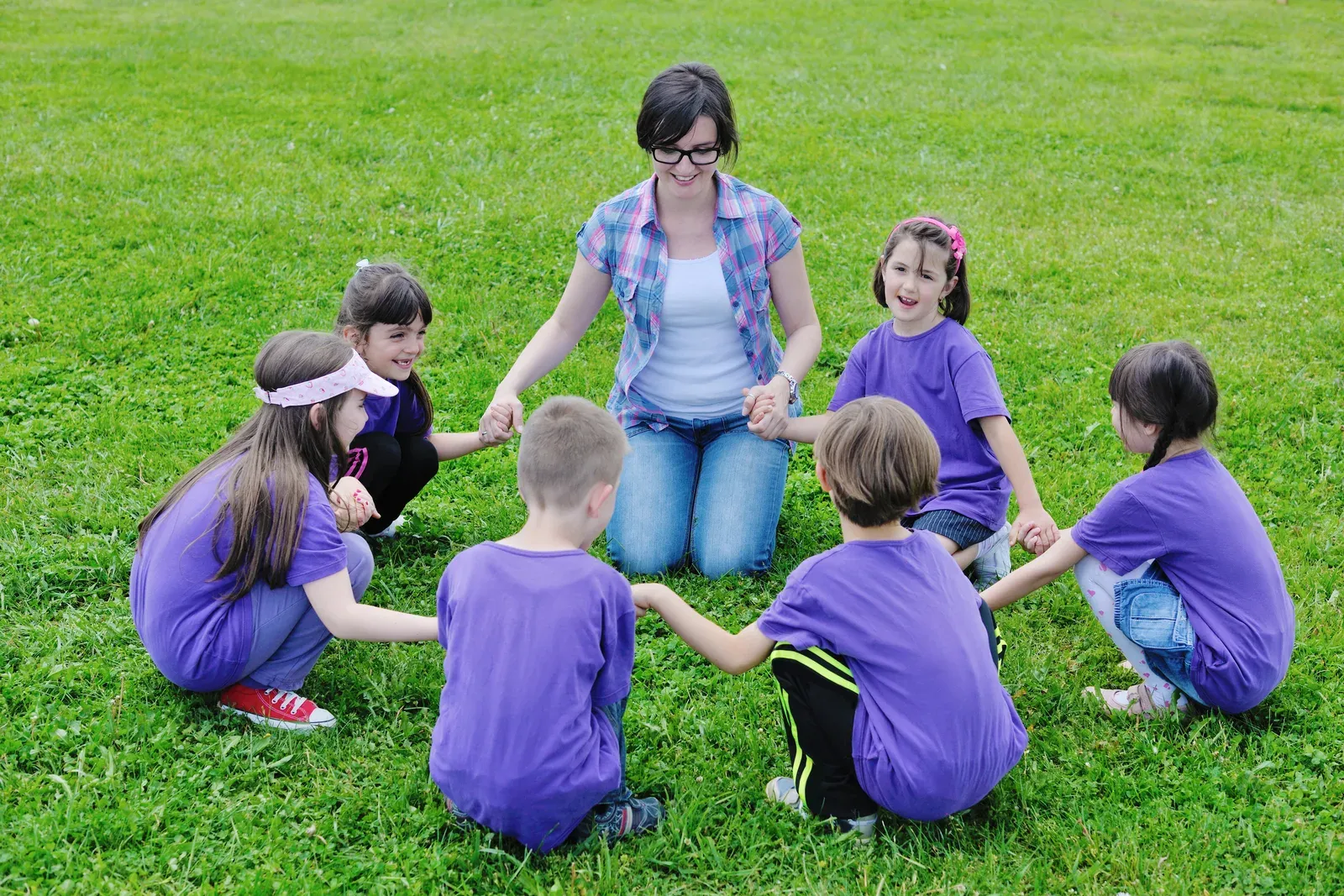
The part of my work that frightens parents most is risk. Children climbing, using real tools, going near fire. My field explanation is in the piece on forest school: a risk is something the child can assess, a hazard is not.
But my explanation is an opinion. Here is what has been published.
Forty studies on risky play
In December 2025, Behavioral Sciences published a scoping review by Tonia Gray and colleagues, which began with 5,218 references and retained 40 empirical studies published between 2015 and 2025 on risky outdoor play and adventure education.
The finding that counts: all 40 studies reported positive associations, across multiple developmental domains. The authors grouped their conclusions into eight themes — resilience and confidence, wellbeing, physical skills, autonomy and agency, nature connectedness, quality play provision, educator influence, and social competence.
Their conclusion is phrased this way: authentic child agency and autonomy functioned as critical mechanisms. Not nature itself, not the height of the tree. The fact that the decision belongs to the child.
Of the eight themes, two interest me professionally more than the rest, because they are the only ones I control: the quality of the space and the influence of the educator. The adult is not neutral in a session involving risk. Their attitude substantially shapes what comes out of it — including, I assume, in the wrong direction.
The meta-analysis on learning in nature
Also in 2025, Education Sciences published a systematic review and meta-analysis on the role of outdoor recreation in the development of children and adolescents aged 6 to 18. The results show significant improvements in psychological wellbeing, social connectivity and environmental awareness.
The age range is worth noting: 6 to 18. Much of the evidence on nature stops at preschoolers, which makes it hard to use when you are talking to a secondary school.
Forest school, separately
Forest school as a distinct method has evidence of its own.
A systematic review published in 2023 in Educational Psychology Review compared kindergarten-age children attending forest school with those staying indoors and found greater benefits across several areas: cognitive function, motor coordination and balance, and connectedness to nature.
A 2025 study in the Journal of Outdoor and Environmental Education looks at something else — children with special educational needs. It measured involvement and found consistently higher levels during forest school sessions than in classroom lessons and than at recess, with particularly notable gains among pupils with SEN. The qualitative data indicated improvements in confidence, social interaction and emotional wellbeing.
The comparison with recess strikes me as the most honest of all. Beating a maths lesson on engagement is easy. Beating break time is much harder.
What I do with this
Three things, very concretely:
I do not sell risk as an attraction. Nothing in the literature above says riskier is better. It says autonomy is the mechanism, and risk is merely the context in which autonomy becomes real. A child who chooses not to climb has used the same autonomy.
I remove hazards beforehand, then step back. My job at a new site is to look for what a seven-year-old cannot assess: the dead branch, the broken fence, the depth of the water. Once I have finished, I stop managing the risk that remains.
I do not present the literature as my guarantee. The studies above are about programmes, not about my workshops. I use them to know what matters — autonomy, repetition, space, the adult’s attitude — not as proof that what I do produces the same results.
For schools, the useful part of the SEN section is that it can be shown to a committee. If we build a programme for your classes, I can include the references in the written proposal, in the form that goes into your documentation.
Sources
- Gray T, Down MJA, Mann J, Barnes J, Sturges M, Eager D, Pigott F, Harper A, Hespos S, Monro Miller R, Reis A — Risky Outdoor Play and Adventure Education in Nature for Child and Adolescent Wellbeing: A Scoping Review, Behavioral Sciences, December 2025 (40 studies from 5,218 references, 2015–2025)
- Learning in Nature: A Systematic Review and Meta-Analysis of Outdoor Recreation’s Role in Youth Development, Education Sciences, 2025, 15(3), 332
- Psychological Benefits of Attending Forest School for Preschool Children: a Systematic Review, Educational Psychology Review, 2023
- Inclusive pedagogy outdoors: forest school and the engagement of students with special educational needs, Journal of Outdoor and Environmental Education, 2025